This story has been restored from the magazine archive. The text is original; outdated contact details have been removed. THE
JIG FISHING SCHOOL Part 1
Text: SFM-toimitus
Translation: SFM-toimitus
Spoons and spinners
were manufactured industrially in Finland as early as in the late 19th
century. They were used in sportfishing instead of both live and dead
baitfish and all other natural lures. In the 1930´s wobbles were
introduced into the Finnish selection of lures. The worldwide triumph of
wobbles took place during the 1950´s with the success of Rapala. Lures
and jigs made of plastic and silicon were developed in the USA as early as
in the 1970´s for angling bass species. In Finland the most innovative
anglers used them already in the late 1980´s, but the mass anglers became
aware of these novelties during the first part of the 1990´s. There are
still a lot of anglers who shy away from these plastic grubs and worms.
This is surely partly due to to fright of tying new kinds of lures at the
end of one´s line and partly accountable to the fact that the jig angling
techniques are not yet very well known. Jigs can be considered the
greatest step forward in sportfishing after the wobbles were invented.
The basic meaning of
the word jig in America is simply 'a lure'. The purpose of this Jig
Fishing School is to familiarize the reader with the jig as a lure; both
as a whole and also as disassembled to its parts. The first part
introduces us the many different kinds of jigtails and -heads and the ways
to offer various grubs and tubes to different fish species. The second
part will show several jig rigs in detail and teach fishing techniques
used with shads and worms.
The jigtails can be classified into five main groups according to their
form:
1. Grubs
2. Shads (fish imitations)
3. Worms
4. Tubes
5. Special jigs
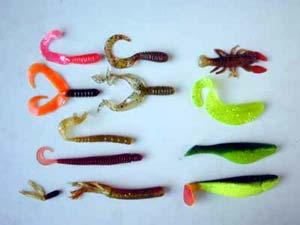
Left up : one and two tail grubs,
under them two worms and the most under two tubes. On right from up a
crayfish, a leech and two shads
Certainly the most commonly used
jigs in Finland are grubs and shads, but also worms, tubes and special
jigs include types that catch well in many fishing situations. When the
pike are are very choosy, you can find the solution to your problem from
for example lizard of frog imitation specials. In fly fishing the
Leech-ties originally imitating leeches are appetizing to rainbow trouts
in backwaters. Jigs also include morsels looking like leeches. Small tubes
have yielded best when luring small lake perch. The worms are good for
fishing all predators but the teeth of a pike will leave their distinctive
marks on a long plastic worm.
In jig fishing the
loss percentage is clearly higher than when you´re fishing with any of
the traditional lures. There are two fundamental reasons for it. Firstly
when fishing with the proper technique the jigs swim in most situations
down by or at the bottom, so Mother Earth will often claim her own.
Secondly jigs are made of plastic and aren´t thus guaranteed for life but
can take only a certain amount of chewing depending on the species. A
greedy long-nosed bonehead can chum a shad according to the principle:
it´s gone once and for all. The popularity of jigs on the other side of
the Atlantic is based on the cheap price of the lure. Unfortunately in
Finland the prices are still relatively high. When I buy one grub at the
price of a few marks, an American angler will get a whole bagful of twenty
grubtails at the same cost. One may hope that since the selling of jigs is
steadily rising the prices, too, will come down as the volume increases.
Grubs and tubes
The grubtail is surely the first impression for
an angler not familiar with jigfishing. The grub consists of two parts.
The forepart often knobby in different ways forms the body. When the body
is covered with small knobs we talk about a Caterpillar jig. The tail
itself is formed like a sickle, arched and flat. The tail is usually
longer than the body, a strip slithering lively from the tiniest motion.
Grubs come in one, two or even fourtailed versions. The size of the lure
can affect the catching ability. The shape of a fourtailed grub is self
evidently clearly superior in size to a onetailed grub of the same length
when swimming. If the perch strike eagerly at for instance a three inch
onetailed plastic grub, the same amount of strikes may be achieved by
using a two inch grub with several tails, because the size of the lure as
a morsel is then just about the same as that of a three inch onetail.
One of the most important
factors arousing interest in fishes is the colour of the tail. Because the
jigtail is a cheap device, the angler can have a much wider selection of
colours in store than when it comes to wobbles costing ten times as much.
Selecting the colour of the tail often presents a problem. Finding the
striking colour is hard when the fish are eating badly. If you have two or
three anglers in the boat, a sensible team will cooperate. Each angler
will start with a tail of a different colour. Then you change the colour
untill one of the team finds the striking colour. When the perch lurk in
deep water you find the striking colour quickly using an illegal chain of
jigs with three to five hooks. After you´ve found the striking colour it
is best to switch back to legal jig fishing. When you build the chain you
tie a lead downmost. Above the lead you tie fly hooks at twenty cm`s
intervals in loop knots, a good hook is streamer 2-4x, sizes 4-8. To each
hook you attach a different coloured grubtail. You let the boat drift with
the wind and angle by the bottom with the chain. When you find the school
of perch the anchor man has to be alert. After settting the anchor you can
angle with the normal techniques using the colours in the chain that the
perches accepted.
The storage problem of
the jigs is connected with their colours. Plastic grubs have corrosive and
dissolvent effects on each other. Grubs of the same colour get well along
with each other but mixing e.g. red and white tails will turn them into a
lump of pink stuff. The different coloured tails have to be kept in their
separate compartments. The jigtails will also corrode several types of
plastic in addition to their own pals. When you buy a box for keeping jigs
you have to make sure the plastic will not be corroded by the jigs, else
you might find a box with holes in it and a mostrous hump of jig slime in
the bottom of your fishing bag. Certain boxes for keeping jigs are for
instance gray polypropylen boxes made by Plano. The models 3600 and 3700
have compartments with adjustable partitions. When needed you can make new
compartments for new colours.
Grubs and tubes are
manufactured in several sizes. The length is given in inches in the
American way. In the Finnish conditions small one inch grubs are well
suitable for fishing perch and roach fish species in lakes. When fishing
rapids small jigs often yield nobler fish like trout, grayling and even
whitefish. The rainbow trouts are in their own category in both rapids and
lakes. The colour scale of jigs is really extensive so it´s possible to
find lures pleasing the eye of stationary rainbow trouts often infatuated
to rather crude shades. Three to four inch tubes are suitable for fishing
at sea. The lunker perch like their bass cousins on the other side of the
Atlantic find a jig bouncing and slithering deliciously at the bottom very
appetizing. A few years ago I used to swear on spinners as perch lures. I
was even prepared to bet outrageously for my old trusted lures. Now I know
I would´ve lost the bet in question and wet my eyes. Because my
experiences in catching perch in the Archipelago Sea have proved that the
grubs, and partly also tubes, are lure number one for lunker perch. The
jig beats the wobbles, spinners and spoons as lures for perch especially
when the fish are feeding down by the bottom. You can also offer small
wobbles or spinners to those stripeshirts suspending or, better still,
feeding on the surface.
In catching zanders
during spring and in the early summer jigs have proved efficient for
several years. When the brass-sides arrive at their wedding places, most
often situated in areas where the depth of the water is less than two
metres, it is time to change your trolling rods and wobbles to lighter
tools suitable for jigging. From May onwards all the way to the middle of
July you are able to catch these delicious phosphorus eyes with casting
gear. Three to four inch grubs and shads are well functioning gatecrashers
at the zander´s wedding. Jigging is effective even after spawning
especially on the grooms that stay at the site in order to guard the
fertilized eggs.
The basic catch
of the angler, the pike, is often eager to taste a slithering grub. Also
when fishing perch the loss percentage of lures is greatly increased by
the greedy grinders whose sharply cutting teeth will snap the line by a
slight turn of the pike´s head. When aiming to catch perch in waters
where there are pike you can avoid frustration by using a thin tungsten
leader. Still, all too often when the perch are choosy in grabbing the
lure you have to tie the lure right to the end of the line without any
snaps or leaders. The grubs best suitable for fishing pike range from four
to six inches. Well known brands are Kalin´s Mogambo Grub and Mister
Twister. Large shads have proved their special value in jigging pike. I
will tell you more about them in part two of the Jig Fishing School.
Weighting
There are two
schools when it comes to joining the jighead and the grubtail together.
One says the sickle tail has to point upwards and the other swears on the
productivity of the downward pointing tail. I, personally, haven´t found
any difference on the productivity of the grub either way. But if the tail
is slanting sideways the lure swims in an angle causing the hook to slip
readily out of the sides of the fish's mouth.

Setting the hook:
1. Measure the length of the straight portion of the
hook for the body of the jig.
2. Push the point of the hook in at the head of the
tail.
3. Slip the hook out at the point you measured
previously.
4. Check that the hook, body and tail are in a straight
line.
5. Make a test run on the lure and if OK start
angling.
This technique of hooking is valid also for tubetails.
Another way to use a fixed lead-hook combination is, in cases the form of
the jighead allows it, to push the lead part of the head all the way
inside the tube. You can also weight a tubetail with a plummet body. The
plummet is threaded on the line in front of the tail. A straight eyed hook
with a shaft of suitable length is pushed in the head end and out the
measured point just as when using a grub. You can also hide both the lead
and the hook in the tube part of the tail. When doing this you have make a
hole at the end of the tube for the line.
The jigheads
A quick count made through the American mail-order store
Cabella´s catalogue gave the result of 24 different jigheads, and they
are definitely not all the different models on the market. The form of the
head affects the swimming of the lure and the way it sets itself when
hitting the bottom. The jigging culture in the USA has progressed so far
that differing shapes of jigheads all have their own names. An ordinary
jig angler will do with a few basic models but it is still good to know
the properties of the heads one uses. A jighead is thus not merely a
weight but its form makes the jig the whole required in a given fishing
situation.
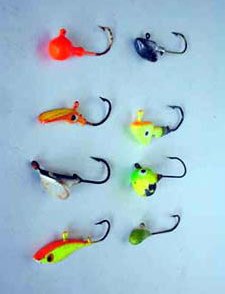
Left row from up to down
A round head with a collar:
-
for grub-, shad- and tubetails
- the barb of the collar stops the tail from sliding
backwards
- the basic model for most fishing situations
- the swimming motion is made by the angler
Grave Digger:
- for
grubtails, especially multiple
- the form gives the lure a wobblelike swimming
motion
- originally meant
for the Grave Digger tails with two front wings added to the
grubtail
Stand Up:
- for grub- and shadtails
- slow reeling slides the jig along the bottom with its
tail wagging upwards
Kuusamo jighead
- Fishes like a balance-jig, when a small 1-2 inches long grub is added
Right row from up to down
Erie:
-
for grubtails
- Erie lift
the to an almost vertical position at the bottom and slides well along
the bottom
- for zanders and
perch when the fish are feeding all the way down at the
bottom
Shad:
- for shadtails
- its arrowlike shape cleaves the water and vegetation well. It´s a
natural
continuation to a shad
Tip Up:
- for grub-, tube- and shadtails
- stands on the bottom on its head and lifts the tail up
- good for catching zander and perch
Banana Head:
- for grub-, tube- and shadtails
- glides well among the vegetation
- the weed protected model fishes well among among weeds
and grasses
So the form of the jighead affects the swimming motions
of the lure supposed to make the fish strike. The colour of the tail is
often the decisive factor in arousing the interest of the fish. As it is,
also the colour of the jighead may cause the final triggering. Especially
zander and perch like red heads. The basic colours of jigheads, and the
most often needed are lead, red, orange, yellow, green, brown and black.
In addition to a normal jighead it is possible to use the weed protected
type, which you can present to fish hiding among the bottom vegetation.
Fishing techniques for grubs and tubes
Productivity of both the grubs and the tubes is based on
the fact that they can be set to swim at a requred depth. In bottom
angling you get the bait right down by the bottom but using jigs you can
make your fishing a lot more active. The biggest mistakes of a rookie jig
angler are hurrying and fear of losing one´s lures. Reeling too fast
brings the jig in through the middle water, while most of the fish are
down by the bottom. Also the fear of losing the lure at the bottom will
cause fussing. because both grubs and tubes react and move very
sensitively you can take it very easy when making them swim.
The technique for jigging near the bottom is as
follows:
1. After the cast you let the jig
sink all the way to the bottom. Keep the rod level. The line will go slack
as the jig reaches the bottom. When it´s dark or twilight a fluorescent
line is an excellent indicator.
2. Lift the rod up in
a 45 degree angle or even higher depending on the required length of the
bounce
3. Lower the rod back to level and reel the slack in.
4. After the bounce wait for the jig to hit the bottom again..
5. Repeat these movements as many times as the line allows.
If the jig body is a type standing on the bottom on its
head like Stand Up or Tip Up you can tighten the line after the jig hits
the bottom and give the jig slight vibrations with the rod. Predators then
get the impression of a shiner groping the bottom or some other delicious
bug.
When fishing with gliding jigheads like the Walleye,
Erie, Bullet or Banana Head you can join slow reeling along the bottom to
the bouncing. A tasty morsel for perch, the eelpout, is a small fish
grubbing about on the bottom, rather slithery in appearance. You can
imitate it by using the gliding technique when using a grubtail in the
colour Motor Oil or similar.
When fishing in the middle water and on the surface one
still has to be patient and calm. Too quick a reeling will take the jig
away from the fish. You can often raise a school of perch up under the
boat or even right by the keel if you take time to jig for a moment just
under the boat after reeling in each cast. When the perch are hungry and
keen to strike you often see eager and obviously jealous schoolmates
following a perch caught in the hook almost all the way to the surface. At
such a situation there´s no reason to make a long cast butyou should
carefully lower the jig back down towards the bottom. You´ll very
propably get a strike before the jig reaches the bottom. The same way of
jigging works well when fishing zander, especially if you have felt even
the tiniest jerks when reeling the lure in.
The main rules in the fishing techniques of grubs and
tubes are:
It is not forbidden to use your imagination
It is worthwhile to vary the techniques with which you
swim the lure.
If
the fish stop biting, change the colour of the tail and try to make the
lure swim in a different way
Be
patient and calm!
In the second part of the Jig Fishing
School:
Shads and worms and their fishing
techniques.
An introduction to jig rigs. For instance: how and what
you can fish using a floating jig body and jigtail.
|