The Giant Pike of Inio
Published · Updated
This story has been restored from the magazine archive. The text is original; outdated contact details have been removed.
THE GIANT PIKE OF INIO
By Jari Tuiskunen
It was the last May of the millennium in Inio. There was one whole and two half days time to play with the spring pike. Luckyly the circumstances seemed promising for once. The sunny, mild weather caressed the fisherman and made it easy to prospect even the more remote hot spots. It was cold though, so that you you had wear overalls, wool caps and woolen half gloves.
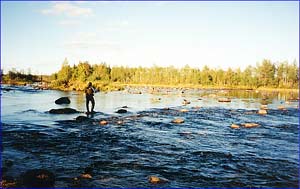
The top moment of the first afternoon was experienced in a strait between Lammholm and Lehamn situated south of Keistio. The strait is actually almost overgrown at its narrowest point i.e. it has turned into a bay. Thick weeds lined this baylet, which offered up to five metres of water in its centre parts and there was also a small islet that broke the surface in the middle of the bay.
At first we were whipping the weedlines and got bored hauling in small pike around a kilogram in weight. There were such amounts of weddeing crowd present that at times every cast produced a fish. And if there was no strike, there was a follow, sometimes two or even three at the same time.
After a score or so midgets ad paid teir due we moved on to cast the central part of the bay. The average size of the pike increased immediately. We boated a dozen or so pike between three and four kilos. Among them there was one weighing 6.8 kilos, which hit a Risto Rap and a few weighing nearly five kilos. To almost all of them we applied the catch and release philosophy. If we hadn´t done so we would´ve spent the whole nightcleaning about 65 pike; that is at least a hundred kilos of them. Also there would have been a panicky search for enough space for cold storage.
The next day, too, was printed as clearly positive in the book of memories.
SMALL PIKE AND SOME NOT SO SMALL
The next morning we motored to have a look at the big bays opening south of Keistiö, of which especially the easternmost seemed interesting even when looking at he chart. We weren´t disappointed. We had before our eyes a basic type of bay witha few metres of water in the middle andwith weedy shallow shorelines. It seemed apparent that there would be plenty of pike gathered there driven by their reproductive instinct.
The outcome was almost a replica of the previous evening; only the amount of fish was a bit reduced. By the weedline we caught the small pike and by the edges of the deep in the middle of the bay we got the bigger ones. I guess the biggest this time was just a bit over five kilos.
As we were coming back we encountered several spots that had yealded well the previous autumn, but that were now totally fisless. But then the eastern shoreline of Svartholm offered us a total surprise. There by a rather normal-looking weedline on a level bottom that was between two and three metres in depth lay an unbelievable amont of pike. Due to the clear water we could see some of them, but most of the fish got out of the boat´s way in good time. There had to be a lot of them, though, because the lures were on the move at almost every cast.
In a small cove the water was a bi deeper in the middle and immediately the pike got bigger. Some between four and five klos ot holes in their jaws and one that we estimated at seven to eight kilos got away. Then the strikes finally ceased and we returned to the cabin to have our own feeding feast.
THE STRIKE OF THE GIANT!
Tha same night I a chance to make personal history in fishing.
We were casting the central deep of a large bay west of Kolkko. My friend was blabbing to his mobile phone: We´re fishing alright; rocking in the middle of this open sea area. Tuiskunen thinks that you have to lookdeep for giant pike. Next we´ll go to Kihti, then the Baltic Sea and the Atlantic and last we will grope the bottom of the deep of the Marians.
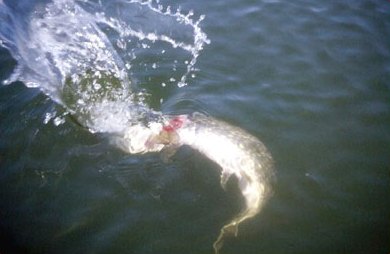
The jokes were still going on when a pike stroke my blue Nilsu-wobble. It didn´t feel any bigger than a three to four kilo fish, but I said something about a tenner. The lunker came up on the surface surprisingly quickly and made a mighty turn there. The joking on the phone stopped instantly as if my pal had been on the head by a club. It was a real giant after all.
Even when I got the pike to the side of the boat I couln´t assess its size accurately. It didn´t look much bigger than the previous six to seven kilo fish we had caught. Not before Jukka put the hook into he fish we began to see the truth. The pike was in an incredibly fat condition and might well break my ancient record of 9.9 kilos.
Digital weighing confirmed our suspections.The scale showed the figures 10.44 kg that is a tennern by a clear margin. The length of the fish was only 104 cm with the tail pressed together, so in my length ranking it was somewhere around eigth place. I have once boated a 114 cm pike and several between 105 and 110 cm, all of which have nevertheless been somewhat under the ten kilo limit. The reason for this has been the time of the year. I¨ve mostly been angling pike during the autumn time.
When we cleaned the pike by the cabin we weighed the spawn bags at a total of two kilograms. If this mummy had had time to spawn, she would´ve weighed only about 7.9 kilos. That was the end of the dream of a real giant pike.